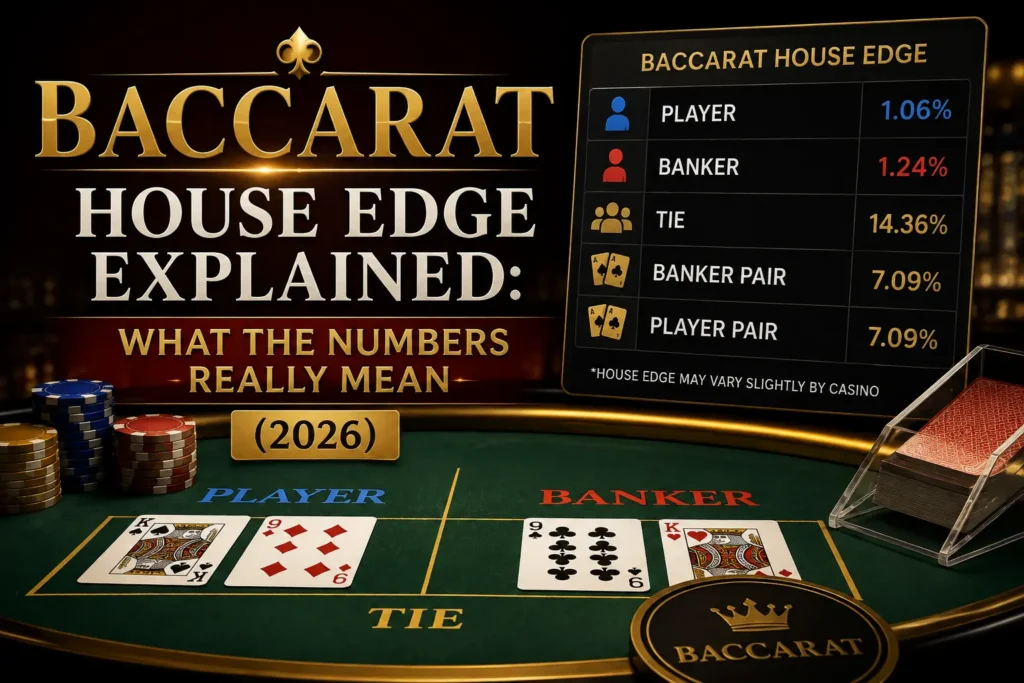
Baccarat House Edge Explained: What the Numbers Really Mean (2026)
Baccarat is a casino card game that is often described as a simple game of chance. The rules are easy to follow, but the mathematics behind the game can be more interesting.
The house edge shows the mathematical advantage that the casino has over the player over a large number of games. It does not predict the result of one hand. Instead, it describes the expected long-term difference between the amount wagered and the amount returned.
Play Baccarat Online | Live Baccarat Games
What Is Baccarat House Edge?
The house edge is the percentage of the money wagered that a casino expects to retain over a very large number of plays.
For example, a house edge of 1% means that the mathematical expectation is that the casino keeps about $1 for every $100 wagered over a sufficiently large sample.
This does not mean that a player will lose exactly $1 after wagering $100. Short-term results can be very different because every hand is a separate random event.
Baccarat House Edge in Simple Terms
Standard baccarat usually has three main outcomes:
- Banker
- Player
- Tie
Each outcome has a different probability and payout structure. For a standard eight-deck Punto Banco game, commonly cited figures are:
| Outcome | Approx. Probability | Typical House Edge |
| Banker | 45.86% | 1.06% |
| Player | 44.62% | 1.24% |
| Tie | 9.52% | 14.36% |
These figures assume standard rules and an 8:1 payout for a Tie. Different baccarat versions can produce different results.
Why Does the Banker Have a Different House Edge?
The Banker outcome has a slightly higher probability of winning than the Player outcome under standard baccarat rules.
However, a winning Banker wager normally pays less than an even-money return because of the standard commission.
The combination of the drawing rules and the commission produces a house edge of about 1.06% for the standard Banker wager.
The important point is that the higher Banker win frequency does not mean that a Banker result is guaranteed.
What Is the House Edge on the Player Outcome?
The standard Player wager has a house edge of about 1.24%. Its mathematical edge is slightly higher than the standard Banker wager.
Again, this number describes a long-run statistical expectation. It does not tell you what will happen in the next hand, the next ten hands, or even the next hundred hands.
That distinction is important when reading baccarat statistics.
Why Does the Tie Have a Higher House Edge?
The Tie outcome occurs less frequently than Banker or Player. Because it is less common, the payout is usually much higher than the payout for the two main outcomes.
However, an attractive payout does not automatically mean a favorable mathematical expectation. With a common 8:1 Tie payout, the house edge is about 14.36% in a standard eight-deck game.
Some tables use different Tie payouts, so readers should always check the actual rules and paytable.
House Edge Does Not Predict Individual Results
This is one of the most important ideas to understand. Suppose a game has a 1% house edge.
That does not mean:
“The casino will win 1% of the next 100 hands.”
It also does not mean:
“A player must lose after a certain number of hands.”
House edge is a statistical measurement calculated over a very large number of outcomes. Short sessions can produce results that are very different from the long-term expectation.
A Simple Example
Imagine a theoretical game with a 1% house edge.
If $100,000 is wagered across a very large number of plays, the mathematical expectation would be approximately $1,000 in casino advantage, but the actual result can be higher or lower.
The same principle applies to baccarat. The house edge describes the underlying mathematics. It is not a prediction for an individual session.
Baccarat Probability vs House Edge
Probability and house edge are related, but they are not the same thing.
1) Probability describes how likely an outcome is to occur.
2) Payout describes how much is returned when that outcome occurs.
3) House edge combines those factors to measure the mathematical advantage of the house.
This is why simply looking at the chance of winning is not enough to understand a game’s mathematics.
Why Payouts Matter
Consider two outcomes with different probabilities. One may occur more frequently but have a lower payout. another may occur less frequently but have a higher payout.
The relationship between these numbers determines the expected mathematical return.
This is why baccarat analysis should consider:
- Probability
- Payout
- Commission
- Game rules
- Number of decks
- Side-bet rules
Looking at only one number can create a misleading picture.
Does Every Baccarat Game Have the Same House Edge?
No.
Baccarat has several variations, and their rules can differ.
Examples include:
- Standard Punto Banco
- No-commission baccarat
- EZ Baccarat
- Side-bet variations
- Different Tie payout versions
Even small rule changes can alter the mathematical expectation.
For example, Wizard of Odds shows that different deck counts and rule variations can change the house edge, particularly for side bets and modified Banker rules.
This is why a reader should check the specific rules of a table rather than assuming that every baccarat game has identical mathematics.
What About Baccarat Side Bets?
Side bets are separate from the main Banker, Player, and Tie outcomes.
Examples can include:
- Player Pair
- Banker Pair
- Perfect Pair
- Dragon-style bonuses
- Other game-specific propositions
Their mathematical properties can be very different from the main wagers. For example, an eight-deck analysis from Wizard of Odds lists a house edge of about 10.36% for the standard Pair bet under the stated rules. This demonstrates why a large advertised payout should not be confused with a low house edge.
House Edge and RTP
Two other terms often appear when discussing casino mathematics:
House Edge
House edge measures the casino’s mathematical advantage.
Return to Player (RTP)
RTP represents the theoretical percentage returned to players over a very large number of plays. For a standard game, the two concepts are closely related.
For example, a 1.06% house edge corresponds to a theoretical RTP of approximately 98.94%. These are long-run mathematical concepts, not guarantees for an individual player.
Can a Strategy Remove the House Edge?
No betting system can change the underlying mathematical rules of a standard baccarat game. Progression systems, streak theories, pattern tracking, and similar approaches do not change the probability structure of the cards.
A previous result also does not force a different result on the next hand. For example, if Banker has appeared several times in a row, that does not mathematically require Player to appear next. Random sequences can contain streaks.
Why Baccarat Results Can Look Predictable
Humans naturally look for patterns.
A sequence such as:
Banker → Banker → Player → Banker → Player → Player
can appear meaningful.
However, observing a pattern does not prove that the next outcome can be predicted.
This is known as the gambler’s fallacy when someone assumes that a previous independent result changes the probability of the next result without a rule-based reason.
Understanding this concept is useful when studying any random game.
What Should Readers Check Before Comparing Baccarat Games?
If you are researching baccarat mathematics, compare the actual rules rather than relying only on the game name.
Look at:
- Number of decks
- Banker commission
- Tie payout
- Drawing rules
- Side-bet rules
- Special payouts
- Any modified Banker outcomes
A small change in the paytable can affect the mathematical expectation.
Why Understanding House Edge Matters
House edge provides a useful way to compare the mathematical structure of different casino games. It also helps readers understand an important distinction:
A low house edge is not the same as a guaranteed positive result.
Even games with relatively low house edges remain games of chance. The house edge operates over large samples, while individual results can vary considerably.
Frequently Asked Questions
What does baccarat house edge mean?
Baccarat house edge is the mathematical advantage that the casino has over a large number of games. It is expressed as a percentage.
What is the standard baccarat house edge?
In a standard eight-deck Punto Banco game, commonly cited house edges are about 1.06% for Banker, 1.24% for Player, and 14.36% for an 8:1 Tie wager.
Does house edge predict the next baccarat result?
No. House edge describes long-term mathematical expectations. It cannot predict an individual hand.
Can baccarat rules change the house edge?
Yes. Different deck counts, commissions, payouts, and special rules can change the mathematical results.
Is a high payout the same as a low house edge?
No. A high payout can be attached to an outcome that occurs less frequently. Probability and payout must be considered together.
What is the difference between house edge and RTP?
House edge represents the mathematical advantage of the casino, while RTP represents the theoretical percentage returned to players over a large number of plays.
Are baccarat patterns reliable predictions?
No. Previous outcomes do not automatically determine future outcomes. Random sequences can contain streaks and repeated results.