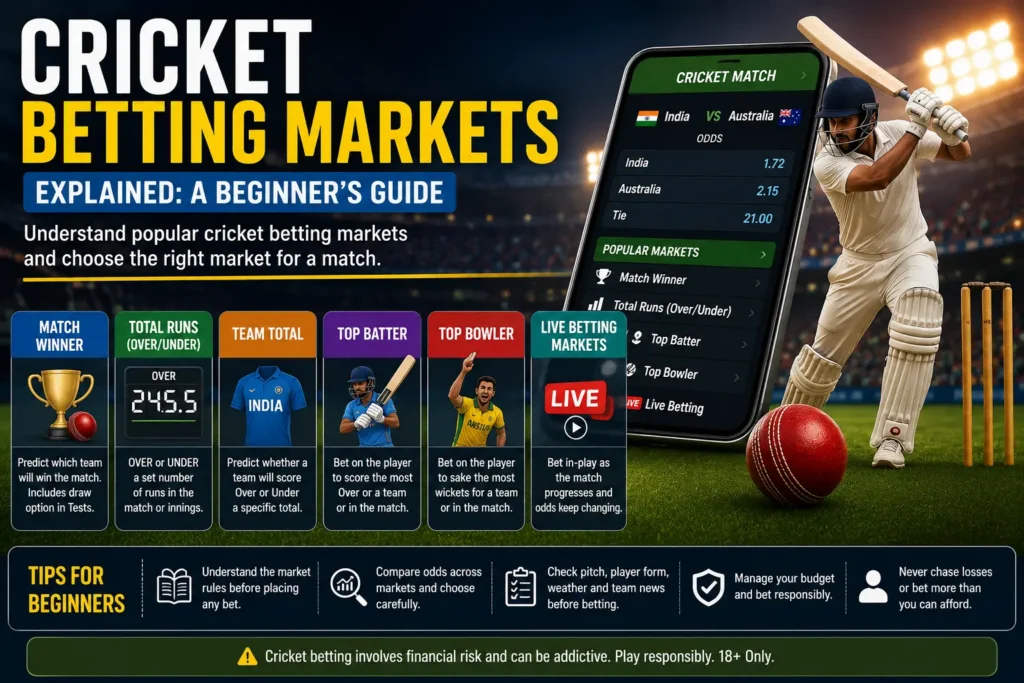
Cricket Betting Markets: A Beginner’s Guide
If you have ever opened a cricket betting page and seen options like match winner, total runs, top batter, top bowler, or live betting, you may wonder what all these choices actually mean. Each option is a different cricket betting market, and each one focuses on a specific outcome or event.
Understanding these markets is important before looking at odds or making any decision. A market tells you exactly what you are predicting. The odds then show the price attached to that outcome.
What Are Cricket Betting Markets?
A cricket betting market is simply a specific outcome connected to a cricket match. Instead of only asking, “Which team will win?”, a market can ask how many runs will be scored, which player will perform best, or what happens during a particular part of the match.
For example, Match Winner focuses on the final result, while Total Runs focuses only on the number of runs scored. These are two completely different markets even though they relate to the same match.
Market names and settlement rules can vary between platforms, so always read the conditions before making a decision.
1. Match Winner Market
The match winner market is usually the easiest one for beginners to understand. It asks which team will win the match.
For example, if India is playing Australia, the market may show both teams with different odds. You select the outcome you believe is more likely according to the market rules.
In Test cricket, a draw can also be possible, so the market may include three outcomes: Team A, Team B, and Draw.
In limited-overs cricket, you should also check how the platform handles ties, Super Overs, abandoned matches, and rain-affected games.
2. Total Runs or Over/Under Market
A total-runs market does not ask who will win. Instead, it focuses on the number of runs scored.
For example, a market may offer a line for whether a team will score over or under a particular number of runs.
This can apply to an entire match, one team’s innings, or a specific period of play. The exact market description is important because the same phrase can have different conditions depending on the competition and platform.
Pitch conditions, weather, batting strength, bowling quality, and match format can all influence scoring.
3. Team Total Market
Team total markets are similar to over/under markets, but they focus on one specific team. Imagine Team A is expected to bat first. A market might ask whether Team A will score above or below a particular run total.
The important difference is that you are not predicting the match winner. A team can lose a match while still going above its team-total line.
4. Top Batter Market
The top batter market focuses on individual player performance.
Depending on the market, the question may be which player scores the most runs for a particular team or which player finishes with the highest score in the match.
Before considering this type of market, check whether the player is expected to be in the playing XI and understand the settlement rules.
Batting position also matters. An opener usually has more opportunity to face deliveries than a lower-order batter, but cricket results are never guaranteed.
5. Top Bowler Market
Top bowler markets work in a similar way but focus on wickets.
The market may ask which player will take the most wickets for a team or across a match. A bowler’s expected number of overs, position in the bowling attack, pitch conditions, and opposition batting lineup can all affect the outcome.
For example, a bowler who regularly delivers during the powerplay or death overs may have different opportunities from a bowler who mainly operates during the middle overs.
6. Player Performance Markets
Some cricket betting markets go beyond simply choosing a top batter or bowler. They focus on specific player statistics.
Examples can include:
- Player runs
- Player wickets
- Player sixes
- Player fours
- Player catches
- Player performance totals
The key thing to remember is that these markets can depend heavily on opportunity. A batter who faces very few balls may have limited chances to reach a runs target, while a bowler who does not complete their expected overs may have fewer opportunities for wickets.
7. Powerplay and Over Markets
Cricket matches can also be divided into smaller sections. This creates markets based on the powerplay, individual overs, or groups of overs.
A market might focus on the number of runs scored during the first six overs or another defined period.
These markets can change quickly because one big over can have a major impact on the final result. They therefore require careful attention to the exact market definition and settlement conditions.
8. Live Cricket Betting Markets
Live or in-play markets become available after a match has started. The odds can change as the game develops.
A wicket, boundary, partnership, bowling change, injury, or sudden change in the required run rate can influence the available prices.
Live betting can therefore look very different from pre-match betting. However, faster-moving markets also leave less time to think, and decisions based purely on excitement or emotion can be risky.
9. Tournament and Series Markets
Not every market is based on one match. Some cover an entire tournament or series.
Examples include predicting:
- Tournament winner
- Series winner
- Top run-scorer
- Top wicket-taker
- Team to qualify
- Tournament finalist
These markets can remain open for a long period, and many things can change before the final result, including player injuries, team form, fixtures, and playing conditions.
How to Choose a Cricket Betting Market
There is no single market that is best for everyone. The most important thing is understanding what the market actually asks before looking at its odds.
A useful approach is to start with markets that are easy to explain. Match winner and simple totals are generally easier to understand than highly specific player or ball-by-ball markets.
You should also compare the market with information you already understand. If you follow a particular team closely, you may understand its batting order, bowling options, and recent performances better than a casual viewer.
Most importantly, never assume that a shorter price means a guaranteed result. Odds represent a market price, not certainty.
Always Check the Settlement Rules
One of the easiest mistakes beginners make is looking only at the odds and ignoring the rules.
Before making any decision, check what happens if:
- The match is abandoned.
- Rain shortens the match.
- A player does not take part.
- A match ends in a tie.
- A Super Over is played.
- A market is suspended or cancelled.
Different markets can have different settlement conditions. Reading these details can prevent confusion later.
Final Thoughts
Cricket betting markets cover much more than simply predicting which team will win. Match winners, total runs, team totals, player performances, powerplay markets, live betting, and tournament markets all ask different questions.
The best starting point is to understand one market at a time. Learn what the market measures, understand the odds, check the settlement rules, and avoid making decisions simply because a team or player is popular.
Understanding a market can make cricket betting terminology easier to follow, but it cannot remove uncertainty or guarantee a winning result. Always check the laws and platform rules that apply to you and keep any betting activity within limits you can afford